
Nationalism
This chapter explains what a nation and nationalism are, why nations claim the right to self-determination, and why democratic nations must be built on shared political ideals rather than a single religion, language or culture.
Prelims loves the factual scaffolding here — matching separatist movements to their countries (Quebecois–Canada, Basques–Spain, Kurds–Turkey/Iraq, Tamils–Sri Lanka), the 19th-century unification of Germany and Italy, the 'imagined community' idea and the Treaty of Versailles. For GS-I Mains it feeds the world-history of nationalism (unification, decolonisation, redrawing of boundaries) and the political-philosophy and society themes of secularism, regionalism, communalism and India's unity-in-diversity. The political-versus-cultural nation debate is a ready-made answer frame for questions on n
Understand the chapter
What Nationalism Is — and Why It Matters
Nationalism is among the most powerful political creeds of the last two centuries, and the chapter's aim is not to explain why it arose but to weigh its claims and aspirations. It is double-edged: it has liberated peoples from oppressive and colonial rule and united them, yet it has also bred deep hatreds, conflict and war. Nationalist struggles have repeatedly drawn and redrawn the boundaries of states and empires, and that re-ordering is not over — separatist struggles persist within seemingly stable states.
- Double-edged: it unites and liberates, but also divides and triggers conflict.
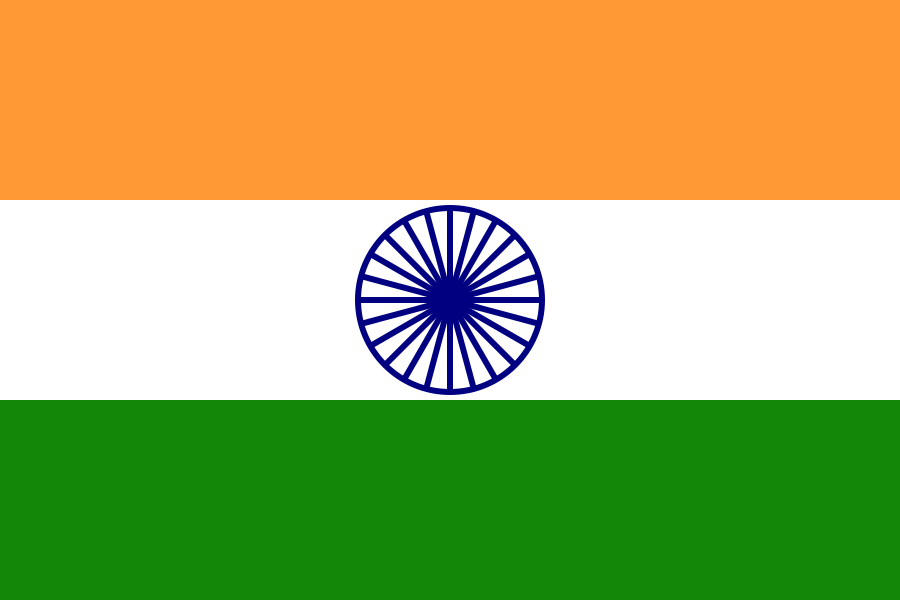
- Republic Day parade — a striking symbol of Indian nationalism's power, strength and diversity.
- Even in a 'global village', nationalism stays relevant (e.g., cheering the Indian cricket team).
Nationalism Through History: Building and Breaking States
Nationalism has passed through several phases that both created and dissolved states. In nineteenth-century Europe it consolidated many small kingdoms into larger nation-states — Germany and Italy were unified this way — while a wave of new states appeared in Latin America, and local dialects and loyalties hardened into common languages and state loyalties. In the early twentieth century the same force broke apart the Austro-Hungarian and Russian empires, and later the British, French, Dutch and Portuguese colonial empires in Asia and Africa, India's freedom struggle being one such nationalist movement. Since 1960 even stable nation-states have faced separatist demands for statehood.
- Unification (build): Germany and Italy forged from small kingdoms; new states in Latin America.
- Break-up (dissolve): Austro-Hungarian and Russian empires; British, French, Dutch and Portuguese colonial empires.
- Post-1960 separatism: Quebecois (Canada), Basques (Spain), Kurds (Turkey/Iraq), Tamils (Sri Lanka).
- Two directions: pan-Arab nationalism seeks to unite; Basque and Kurd movements seek to divide.
What Is a Nation? The 'Imagined Community'
A nation is not a casual collection of people, yet it differs from every other human group. Unlike a family (face-to-face knowledge) or tribes, clans and kinship groups (bound by descent and marriage), members of a nation may never meet most fellow nationals nor share any ties of descent. There is no single characteristic — language, religion, race or descent — common to all nations; Canada has English and French speakers, and India many languages and religions. A nation is therefore largely an 'imagined community', held together by the collective beliefs, aspirations and imaginations of its members.
- Not like a family (personal knowledge) or tribe/clan (descent and marriage ties).
- No universal marker: many nations lack a common language (Canada) or religion.
- 'Imagined community' — bound by shared belief, not by physical or biological facts.
The Four Pillars That Constitute a Nation
The chapter identifies four assumptions on which the sense of nationhood rests. Shared beliefs come first — like a team, a nation exists only when its members believe they belong together. A nation also claims a continuing history (collective memories, legends and records — Nehru's The Discovery of India invoked India's civilisational 'oneness') and identifies with a territory or homeland (motherland, fatherland or holy land). The decisive fourth pillar is a set of shared political ideals — a common vision of the state and values such as democracy, secularism and liberalism — which truly distinguishes a nation from other groups.
- Shared Beliefs — a nation is constituted by belief, like a team that thinks of itself as one.
- History — continuing historical identity via collective memory; Nehru's The Discovery of India.
- Territory — a 'homeland' (motherland/fatherland/holy land); rival claims breed conflict.
- Shared Political Ideals — common political vision; the strongest test of loyalty is accepting mutual obligations.
Political vs Cultural Nationalism
Should a nation rest on a shared culture (common language, religion or descent) or on shared political values? The chapter argues firmly for the political conception. Imposing one religion is dangerous because all major religions are internally diverse, with many sects, so forcing a single interpretation breeds an authoritarian, oppressive society; imposing one language or religion in a culturally plural society inevitably excludes and disadvantages some groups, violating democracy's core promise of equal treatment and liberty for all. Democracies should therefore demand loyalty to values enshrined in the Constitution, not to a particular religion, race or language.
- Reason 1: religions are internally diverse (sects) — a single imposed creed turns oppressive.
- Reason 2: societies are plural — one religion or language excludes and disadvantages minorities.
- Verdict: imagine the nation politically, not culturally — loyalty to the Constitution's values.
National Self-Determination and Its Costs
Unlike other social groups, nations claim the right to self-determination — to govern themselves and win international recognition as a distinct state, sometimes to protect or even privilege their culture. The nineteenth-century idea of 'one culture–one state' was used to redraw boundaries after World War I: the Treaty of Versailles created several small new states but could not satisfy every demand. The human cost was severe — mass migration, millions displaced and expelled, and communal violence — and even then almost no new state ended up ethnically homogeneous.
- Self-determination = a nation's claimed right to rule itself and gain statehood and recognition.
- 'One culture–one state' guided the post-WWI Treaty of Versailles reordering.
- Cost: forced migration, displacement and communal violence — yet states stayed multi-ethnic.
Case Study — The Basque Movement
Basque is a hilly, prosperous region recognised as an 'autonomous' region within Spain's federation, but its nationalist leaders want a separate country and have used both constitutional and (until recently) violent means. They argue their culture and language are wholly distinct from Spanish — though only about one-third of Basques understand the language today — and that the region kept its own justice, administration and finance and never surrendered autonomy since Roman times. The modern movement began in the late nineteenth century when Spain tried to abolish this arrangement, and the dictator Franco later banned the Basque language even at home; though repression has since been withdrawn, mistrust of Madrid and of 'outsiders' persists.
- Status: an 'autonomous' region within Spain; leaders still demand full statehood.
- Distinctiveness: unique language (only about one-third understand it), hilly terrain, age-old self-rule.
- Franco banned the Basque language; repression now lifted but suspicion of 'outsiders' continues.
Key terms
- Nation
- A large body of people who believe they belong together and aspire to an independent political existence, even without shared descent, language or religion.
- Nationalism
- The political creed asserting that a nation is entitled to form and govern its own state.
- Imagined community
- A nation seen as held together not by face-to-face ties but by shared beliefs, memories and aspirations its members imagine they hold in common.
- Nation-state
- A state whose people identify as a single nation; the dominant political unit of the modern world.
- National self-determination
- A nation's claimed right to govern itself and gain international recognition as a separate state.
- One culture–one state
- The 19th-century European idea that each distinct culture should have its own state, used to redraw post-WWI boundaries.
- Political nationalism
- Defining the nation by shared political values and the Constitution rather than a common religion, language or race.
- Separatism
- A movement by a group or region to break away from an existing state and form its own.
- Autonomous region
- A territory granted self-government within a larger state (e.g., Basque within Spain), short of full independence.
Must-know facts exam-ready
- 'Imagined community' as a description of the nation is associated with Benedict Anderson (Imagined Communities, 1983).
- 19th-century unification created Germany (1871) and Italy (1861) from small kingdoms; new states also arose in Latin America.
- Early-20th-century break-ups: the Austro-Hungarian and Russian empires, and later the British, French, Dutch and Portuguese colonial empires.
- Treaty of Versailles (1919) redrew post-WWI borders on the 'one culture–one state' idea but could not satisfy every demand.
- Separatist movements: Quebecois–Canada, Basques–northern Spain, Kurds–Turkey and Iraq, Tamils–Sri Lanka.
- Basque is an 'autonomous' region within Spain; only about one-third of Basques understand the Basque language.
- The dictator Franco banned the Basque language in public places and homes; the ban was later withdrawn.
- Nehru invoked India's civilisational 'oneness' in The Discovery of India (written 1944).
- The Jewish people regarded Palestine — the 'promised land' — as their original homeland.
- Pan-Arab nationalism seeks to unite Arab states, whereas Basque and Kurd movements seek to divide existing states.
- Citizens' obligations and loyalty echo India's Fundamental Duties — Article 51A, inserted by the 42nd Amendment (1976) on the Swaran Singh Committee's recommendation.
Timeline
- 1861Unification of Italy — small kingdoms consolidated into the Kingdom of Italy.
- 1871Unification of Germany — small states forged into a single nation-state.
- Late 19th c.Modern Basque Nationalist Movement begins as Spain moves to abolish Basque autonomy.
- 1917–1918Break-up of the Russian and Austro-Hungarian empires in Europe.
- 1919Treaty of Versailles redraws boundaries on the 'one culture–one state' idea after World War I.
- 1944Nehru writes The Discovery of India, invoking India's civilisational 'oneness'.
- Since 1960Even stable nation-states confront fresh separatist and statehood demands.
Memory tricks remember it for good
Traps to avoid
- Nation ≠ State ≠ Nation-state: a 'nation' is a community that believes it belongs together, a 'state' is a political-legal entity, and a 'nation-state' is when the two coincide — don't equate them.
- A common language, religion or race is NOT necessary for a nation — Canada and India have none; the chapter rejects any single defining marker.
- Nationalism both unifies AND divides — it built Germany and Italy but also broke up empires; treating it as only positive (or only negative) is the trap.
- The chapter favours POLITICAL nationalism (loyalty to the Constitution's values), not CULTURAL nationalism (one religion or language) — don't reverse its stance.
- Self-determination does not automatically mean separate statehood — the chapter asks whether nationalist claims can be met without a new state, and critiques 'one culture–one state' rather than endorsing it.
- Basque is already an 'autonomous' region within Spain, not an independent country — autonomy is not statehood, which is exactly why the movement continues.
Exam focus
🧠 Prelims angles
- Match-the-following: separatist group with country (Quebecois–Canada, Basques–Spain, Kurds–Turkey/Iraq, Tamils–Sri Lanka).
- Who/what is linked to the 'imagined community' idea (Benedict Anderson) — a favourite conceptual MCQ.
- Treaty of Versailles (1919), 'one culture–one state', and the redrawing of boundaries after World War I.
- 19th-century unification of Germany and Italy as examples of nation-building.
- Basque facts: an 'autonomous' region in Spain, a distinct language, Franco's language ban.
- The four constitutive features of a nation (Beliefs, History, Territory, Political ideals) and the political-versus-cultural distinction.
✍️ Mains angles GS-I
- 'Nationalism has been both a creator and a destroyer of states.' Discuss.Balance unification (Germany, Italy) and liberation (decolonisation) against the break-up of empires and separatist violence; conclude with the democracy link.
- Should a nation be defined by shared culture or by shared political values?Argue for the political conception using the chapter's two reasons (religions are internally diverse; societies are plural); anchor loyalty in the Constitution.
- Examine the relationship between democracy and national self-determination.Self-determination need not mean new statehood; show how democratic accommodation (rights, autonomy, secularism) can meet nationalist claims without partition.
- Why is 'one culture–one state' a flawed basis for organising the world?Use the Treaty of Versailles aftermath — forced migration, communal violence and persisting multi-ethnic states.
Last-minute revision tick as you recall
- Nation = a community that believes it belongs together; an 'imagined community' (Anderson).
- No single marker (language/religion/race) defines all nations — Canada and India prove it.
- Four pillars: shared Beliefs, History, Territory, Political ideals.
- Prefer POLITICAL over CULTURAL nationalism — loyalty to the Constitution's values.
- Two reasons against a cultural nation: religions are internally diverse; societies are plural.
- Nationalism builds (Germany 1871, Italy 1861) and breaks (empires, colonies).
- Self-determination is not automatic statehood; 'one culture–one state' (Versailles 1919) was costly.
- Separatists: Quebecois–Canada, Basques–Spain, Kurds–Turkey/Iraq, Tamils–Sri Lanka.
- Basque = an 'autonomous' region in Spain; Franco banned its language; about one-third speak it.
Distilled from NCERT Class 11 · Political Theory for UPSC. Always cross-check facts with the original NCERT.